Monday Morning, another beautiful day. Kelly is behind the wheel, and take off back towards Sonoma County for our appointments.
A note about Tim-Tim (a.k.a: Timmy T, Tim-Tom, you stupid piece of shit): At the beginning of this trip, I sat on the floor and very carefully programmed the addresses into "Our Favorites". Now sometimes it can be confusing, as the town borders are kind of funky, un-named dirt roads, no street numbers, etc...). Ergo, he occassionally tries to send us off-roading in our little Avenger and tells us we "have reached our destination" 1/2 a mile shy.
We are rolling thru the beautiful hills and curves of the Dry Creek region, blindly following Tim-Tim's direction, when he directs us to "turn left ahead" on a dirt/mud track thru the vineyard. Luckily, we had recently seen a sign for the winery and took off.
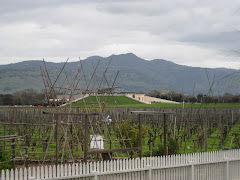
Michel Schlumberger is all organic and sustainable farming (no chemicals, no pesticides, let Mother Nature do her thing and keep an eye on the enviroment around you). We are greeted by Jerry (hospitality), Judd (the financial man), and Mike (the wine maker) and set off for a walk around the property. There are chickens (used for pesticide control) and sheep (used for landscaping and mowing), complete with mobile pens that can be moved about. Sheep are preferred over goats, as goats (a) eat everything in sight and (b) chew the grass too low. There are bird house everywhere, with over 45 species on the property.
We wandered around the property, which is also bordered by "wine creek". Mike and the team keep this area "silt free" and the owner installed a rather elaborate drainage system underground to filter/clean the water before dumping it in the steam. Steelhead and Salmon also rush up and spawn in this creek (Melissa's wine pick" The La Brume Chardonnay)
We unpack the little Avenger, which has developed a brake and power steering problem, and head to Seghesio for a tasting. Seghesio is a very old family operation, with Italian roots going back to the Gold rush in the late 1800's. Great zin's (Melissa's pick: Try the Arneis if you can find it).
After Seghesio, we stroll around the town of Healsdsburg (some alone time, if you will). Kim and I grab dinner, while Kelly opts for Thai food at a later time. We head back to Schlumberger, our accomodations for the evening, where Kelly and I sit on our patio overlooking the western portion of the land and Kim heads for a hike (Stories about Mountain lions don't scare her!).
We sit in our courtyard, eating and drinking until the coyotes STOP making noise (Melissa assumes they are on the move) and hit the sack.
Monday, February 4, 2008


Seghesio Family Vineyards
The Seghesio Story begins in 1886 when Edoardo Seghesio departed his family’s vineyards in Piedmonte, Italy for a new life in America. Like so many immigrants, he was drawn to Northern Sonoma County and the Italian Swiss Colony, to follow his passion for winemaking. The “colony,” as it was known, hired immigrants for three year stints, providing room and board and then, a lump sum at the end of those three years enabling employees to buy land or set up a business in their new home.
Soon, Edoardo rose through the ranks to winemaker. Yet, he yearned for home. The Colony’s manager repeatedly encouraged him to stay and finally, it was his niece and the opportunity to purchase land that convinced Edoardo to remain. That young girl, Angela Vasconi and Edoardo were married in 1893. In 1895, they purchased a modest home in northern Alexander Valley, less for the home than the surrounding 56 acres Edoardo recognized as ideal vineyard land. They planted the “Home Ranch” that year to what has become our family’s lifeline – Zinfandel.
Edoardo remained at the Colony while building his own winery in the evenings after work. Upon its completion in 1902, the young couple began Seghesio Winery while raising their five children. In 1910, they acquired additional acreage surrounding the bustling train station in what was then “Chianti, California.” Edoardo, appropriately, planted the 10 acres to the Chianti field blend of Sangiovese, Canielao Nero, Trebbiano and Malvasia. That vineyard, we call Chianti Station is North America’s oldest planting of Sangiovese.
In the years preceding Prohibition, the business flourished and the Seghesio Family gained a reputation for quality wine and their generosity toward others getting their start in this fledgling industry.
Six months prior to Prohibition, and convinced it could not last more than a year, Edoardo made a decision to purchase his former employer, Italian Swiss Colony. The “Colony” with a 4,000,000 gallon capacity winery and its 1100 acres of vineyards were quite a value at $127, 500. As Prohibition prevailed, however, the debt was too much for Edoardo to bear. In 1920, he brought on partners, his brother-in-law, Enrico Prati, and the Rossi Family who were previous owners and at whose request Edoardo came to America. Edoardo sold his shares in 1933.
Upon repeal of Prohibition, the family once again opened the doors of the winery and Seghesio was making a come back. Unfortunately, Edoardo passed away in 1934 leaving the winery and all property to Angela. From then, Angela and her sons, Arthur, Frank and Eugene continued making wines and shipping via the railroad. With their hard-earned knowledge, they added vineyards when they could purchase them without debt. In 1949, they purchased a second winery facility in Healdsburg to enable them to keep up with the growing demand for their wines.
In January 1958, the newspaper headlines read that Sonoma County’s wine industry had lost its matriarch when Angela passed away. Angela’s legacy as an industry leader and a great chef lives on in her grandchildren. Her sons formed a partnership based on the ideals of their parents, family, hard work and passion for the industry.
From the time of Angela’s death until the mid 1970s, the Seghesio Family flourished in the bulk wine business, producing most of the red wine made in Sonoma County. At their largest, 1,700,000 gallons were produced between the original winery in Chianti and the Healdsburg winery. Yet, as the industry evolved, so did the Seghesio family when in 1983, the first wines were bottled under the Seghesio label at the hands of Ted Seghesio, a fourth generation family winemaker.
Ted was the not only the winemaker but sold and delivered wine. In 1986, his cousin Peter Seghesio joined the business and began to set up a distribution network nationwide. By 1993, the Seghesio brand had grown to 130,000 cases of not only the family’s zinfandel and Italian varietals, but also Chardonnay, Cabernet, Sauvignon Blanc and both red and white table wine. It was in that year that the younger generation was given control of the winery. Fortunately, they too shared a passion for the land and a desire to produce wines they were passionate about. They turned their focus to the vineyards and eliminated all but the wines we grow reducing production to 30,000 cases.
Today, they are proud to passionately produce almost exclusively estate wines, some from those same vineyards Edoardo and Angela first planted in the late 1800s.
Soon, Edoardo rose through the ranks to winemaker. Yet, he yearned for home. The Colony’s manager repeatedly encouraged him to stay and finally, it was his niece and the opportunity to purchase land that convinced Edoardo to remain. That young girl, Angela Vasconi and Edoardo were married in 1893. In 1895, they purchased a modest home in northern Alexander Valley, less for the home than the surrounding 56 acres Edoardo recognized as ideal vineyard land. They planted the “Home Ranch” that year to what has become our family’s lifeline – Zinfandel.
Edoardo remained at the Colony while building his own winery in the evenings after work. Upon its completion in 1902, the young couple began Seghesio Winery while raising their five children. In 1910, they acquired additional acreage surrounding the bustling train station in what was then “Chianti, California.” Edoardo, appropriately, planted the 10 acres to the Chianti field blend of Sangiovese, Canielao Nero, Trebbiano and Malvasia. That vineyard, we call Chianti Station is North America’s oldest planting of Sangiovese.
In the years preceding Prohibition, the business flourished and the Seghesio Family gained a reputation for quality wine and their generosity toward others getting their start in this fledgling industry.
Six months prior to Prohibition, and convinced it could not last more than a year, Edoardo made a decision to purchase his former employer, Italian Swiss Colony. The “Colony” with a 4,000,000 gallon capacity winery and its 1100 acres of vineyards were quite a value at $127, 500. As Prohibition prevailed, however, the debt was too much for Edoardo to bear. In 1920, he brought on partners, his brother-in-law, Enrico Prati, and the Rossi Family who were previous owners and at whose request Edoardo came to America. Edoardo sold his shares in 1933.
Upon repeal of Prohibition, the family once again opened the doors of the winery and Seghesio was making a come back. Unfortunately, Edoardo passed away in 1934 leaving the winery and all property to Angela. From then, Angela and her sons, Arthur, Frank and Eugene continued making wines and shipping via the railroad. With their hard-earned knowledge, they added vineyards when they could purchase them without debt. In 1949, they purchased a second winery facility in Healdsburg to enable them to keep up with the growing demand for their wines.
In January 1958, the newspaper headlines read that Sonoma County’s wine industry had lost its matriarch when Angela passed away. Angela’s legacy as an industry leader and a great chef lives on in her grandchildren. Her sons formed a partnership based on the ideals of their parents, family, hard work and passion for the industry.
From the time of Angela’s death until the mid 1970s, the Seghesio Family flourished in the bulk wine business, producing most of the red wine made in Sonoma County. At their largest, 1,700,000 gallons were produced between the original winery in Chianti and the Healdsburg winery. Yet, as the industry evolved, so did the Seghesio family when in 1983, the first wines were bottled under the Seghesio label at the hands of Ted Seghesio, a fourth generation family winemaker.
Ted was the not only the winemaker but sold and delivered wine. In 1986, his cousin Peter Seghesio joined the business and began to set up a distribution network nationwide. By 1993, the Seghesio brand had grown to 130,000 cases of not only the family’s zinfandel and Italian varietals, but also Chardonnay, Cabernet, Sauvignon Blanc and both red and white table wine. It was in that year that the younger generation was given control of the winery. Fortunately, they too shared a passion for the land and a desire to produce wines they were passionate about. They turned their focus to the vineyards and eliminated all but the wines we grow reducing production to 30,000 cases.
Today, they are proud to passionately produce almost exclusively estate wines, some from those same vineyards Edoardo and Angela first planted in the late 1800s.
Michel Schlumberger
 The special growing conditions of Dry Creek Valley give its wines a character of elegance. The relatively cool growing season nourishes a distinctive balance in the Valley's grapes, ripening them slowly and evenly. The French would say point, or just right. Both red and white wine grapes retain a measure of acidity, lending themselves to making exuberant wines with lively flavors. The red wine grapes also typically have healthy levels of tannins. These are unabashed tannins, and the better cabernets in particular wear them like a nicely tailored suit. Acidity provides freshness and lift; tannins provide immense flavor interest that bring a person back again and again. Both allow a wine to age handsomely. Notched into the western edge of Dry Creek Valley like a small amphitheater, Wine Creek Canyon nicely sets the stage for ripening point. The Canyon juts into the coastal range just at Dry Creek's temperate mid-section, piercing the Valley's western flank. Michel-Schlumberger's rolling benches buttress the Canyon's northern hillsides, and generally slope south, an exposure that gives them a full day's worth of sun. At the same time, vineyards on these benches are closer to the ocean than most-the Pacific is only seventeen miles away. Shortly after five o'clock the ocean air arrives, and during the ripening season Michel-Schlumberger's vineyards are among the first to cool down. At the end of a working day, if you were to walk along the forest at the western edge of our vineyards, you would experience this change of climate firsthand. It is the time of day when the sun has closed upon the horizon and shadows are cast long over the vines. Ahead, on the terraced uplands to the north, grow the treasured Jackson clones of cabernet. Most of those vines are still in sunlight, and should you step out into that light, you would feel the heat of a western day. But here in the shadows a distinctly cool and constant breeze has begun to flow out of the trees and into the vineyards. This breeze feels remarkably like air conditioning. Its noteworthy cooling power goes a long way toward explaining how grapes in this little pocket canyon can ripen fully, and succulently, without losing their composure.
On a rare bit of level ground in Wine Creek Canyon sits the white-clad winery of Michel-Schlumberger. On three sides, vineyards are stitched across rolling foothills, and the mission-style structure is nestled comfortably in its surroundings. Wine Creek flows out of the hills and quietly runs by the front of the winery. To one side is a broad shoulder of a bench, ridged along  the top and fanning out down to the road. There are nearly twenty blocks of vineyards (and an olive orchard) on this shoulder with different exposures and elevations. To the other side of the waterway are a series of knolls surrounding a lake above the winery. Each knoll has its peculiarities, hence its own selection of grapes, rootstock, and spacing. Below the lake is another broad shoulder fanning down to the road. The soil here is "river conglomerate," a particularly rocky soil unique to Dry Creek with superb drainage. Above the lake is the terraced upland vineyard, rising steeply to a saddle on the hill. This vineyard grows in the red volcanic soil of Dry Creek Valley's hinterlands, long prized for premium vineyards. In these red volcanic soils grow our Jackson clones of cabernet sauvignon. This species of cabernet (prosaically known as #6)
  takes its name from a long lost vineyard in the Sierra foothills. In the 19th century UC Berkeley maintained it as an index vineyard. Lore has it that the vineyard lay utterly abandoned after Prohibition, only to be re-discovered by a graduate student researching available plant material in the mid-1960s. The really exciting thing about this wild vineyard is that its vines are pre-phylloxera selections, dating from the mid-19th century. They are free of disease and have never had to undergo modern horticultural remedies such as sterilizing heat treatments. These vines also yield meager amounts of grapes, which almost certainly accounts for their lack of acceptance by the grape growers of yesteryear. But while the quantity of grapes may be paltry, the quality of flavor is exceptional, which is why today the Jackson clones are embraced by California's best estate wineries. The Jackson signature is rich varietal spice and earthy minerality with unusually concentrated, lavish, mouth-filling fruitiness, coupled with surprising clarity and elegance- achieved without numbing levels of alcohol. The various Jackson clones of cabernet, petit verdot, and pinot noir are especially promising, and our vineyards include clones of all three varieties. Over the years Michel-Schlumberger has garnered a reputation for its structured and aromatic merlot. Many of our most recently planted merlot clones grow on Riperia Gloria rootstock. Highly regarded in Bordeaux, this rootstock is quite rare in Sonoma County because it is the most vigor-limiting rootstock available-again, meager grapes with exceptional flavors. As in the past, small amounts of cabernet and cabernet franc are blended with the merlot. To add to this complexity, we have planted petit verdot and malbec to blend for color and spice. The syrah vines consist of several clones planted on both the benchlands and on Bradford Mountain, where these vines share our steep slope with five other varieties. Grapes from the mountain have excellent acidities coupled with depth and intensity of flavor; grapes from the benchlands have broader flavors, more generous and less etched in profile. Small amounts of zinfandel and viognier are blended into the syrah. Much the same as grenache in
  southern France, Dry Creek zinfandel gives broad, spicy flavors to syrah's deep dark density. Viognier lifts the aromatics into a lovely perfume. We are making a small amount of pinot noir from two Jackson clones and four Dijon clones recently made available from France. Ours has none of the green flavors and high alcohol that commonly mar new world pinot noir. Rather, it is a wine of fragrance, filled with flavors of pure black cherry fruit, and finishing with length and elegance. Our chardonnay program has been completely renewed. Gone are the old plantings of the Wente clone, long the mainstay of California chardonnay; replacing them are several Dijon clones and the famous Robert Young clone. In the years to come, we will introduce at least one (possibly two, should distinctions merit) vineyard-designated chardonnay. We hope that it will show the real potential of Dry Creek Valley for this variety. Lastly, we will continue to make authentic pinot blanc from Alsatian clones. Jacques Schlumberger's family comes from Alsace
  and this variety is a natural one for us. Our rendition has always been crisp and spry, redolent of fresh melon. The high-density plantings, growing in some of our coolest terroirs, or growing areas, soon will add a further dimension of flavor to this wine. Terroir, a simple concept of place, is not some marketing idea to which we pay lip service. It is a defining idea for Michel-Schlumberger. We have gone to great lengths to match plant material, spacing, and trellising to specific sites in order to best take advantage of each site's characteristics. We farm these parcels conscientiously and ecologically in order to nourish the ground and their vines. The nuance of a great wine, its heart and soul and individuality, comes from the soil and its vines. One can nudge a wine here and there in the cellar, but the quality and personality come from the vineyard.
 the top and fanning out down to the road. There are nearly twenty blocks of vineyards (and an olive orchard) on this shoulder with different exposures and elevations. To the other side of the waterway are a series of knolls surrounding a lake above the winery. Each knoll has its peculiarities, hence its own selection of grapes, rootstock, and spacing. Below the lake is another broad shoulder fanning down to the road. The soil here is "river conglomerate," a particularly rocky soil unique to Dry Creek with superb drainage. Above the lake is the terraced upland vineyard, rising steeply to a saddle on the hill. This vineyard grows in the red volcanic soil of Dry Creek Valley's hinterlands, long prized for premium vineyards. In these red volcanic soils grow our Jackson clones of cabernet sauvignon. This species of cabernet (prosaically known as #6)
  takes its name from a long lost vineyard in the Sierra foothills. In the 19th century UC Berkeley maintained it as an index vineyard. Lore has it that the vineyard lay utterly abandoned after Prohibition, only to be re-discovered by a graduate student researching available plant material in the mid-1960s. The really exciting thing about this wild vineyard is that its vines are pre-phylloxera selections, dating from the mid-19th century. They are free of disease and have never had to undergo modern horticultural remedies such as sterilizing heat treatments. These vines also yield meager amounts of grapes, which almost certainly accounts for their lack of acceptance by the grape growers of yesteryear. But while the quantity of grapes may be paltry, the quality of flavor is exceptional, which is why today the Jackson clones are embraced by California's best estate wineries. The Jackson signature is rich varietal spice and earthy minerality with unusually concentrated, lavish, mouth-filling fruitiness, coupled with surprising clarity and elegance- achieved without numbing levels of alcohol. The various Jackson clones of cabernet, petit verdot, and pinot noir are especially promising, and our vineyards include clones of all three varieties. Over the years Michel-Schlumberger has garnered a reputation for its structured and aromatic merlot. Many of our most recently planted merlot clones grow on Riperia Gloria rootstock. Highly regarded in Bordeaux, this rootstock is quite rare in Sonoma County because it is the most vigor-limiting rootstock available-again, meager grapes with exceptional flavors. As in the past, small amounts of cabernet and cabernet franc are blended with the merlot. To add to this complexity, we have planted petit verdot and malbec to blend for color and spice. The syrah vines consist of several clones planted on both the benchlands and on Bradford Mountain, where these vines share our steep slope with five other varieties. Grapes from the mountain have excellent acidities coupled with depth and intensity of flavor; grapes from the benchlands have broader flavors, more generous and less etched in profile. Small amounts of zinfandel and viognier are blended into the syrah. Much the same as grenache in
  southern France, Dry Creek zinfandel gives broad, spicy flavors to syrah's deep dark density. Viognier lifts the aromatics into a lovely perfume. We are making a small amount of pinot noir from two Jackson clones and four Dijon clones recently made available from France. Ours has none of the green flavors and high alcohol that commonly mar new world pinot noir. Rather, it is a wine of fragrance, filled with flavors of pure black cherry fruit, and finishing with length and elegance. Our chardonnay program has been completely renewed. Gone are the old plantings of the Wente clone, long the mainstay of California chardonnay; replacing them are several Dijon clones and the famous Robert Young clone. In the years to come, we will introduce at least one (possibly two, should distinctions merit) vineyard-designated chardonnay. We hope that it will show the real potential of Dry Creek Valley for this variety. Lastly, we will continue to make authentic pinot blanc from Alsatian clones. Jacques Schlumberger's family comes from Alsace
  and this variety is a natural one for us. Our rendition has always been crisp and spry, redolent of fresh melon. The high-density plantings, growing in some of our coolest terroirs, or growing areas, soon will add a further dimension of flavor to this wine. Terroir, a simple concept of place, is not some marketing idea to which we pay lip service. It is a defining idea for Michel-Schlumberger. We have gone to great lengths to match plant material, spacing, and trellising to specific sites in order to best take advantage of each site's characteristics. We farm these parcels conscientiously and ecologically in order to nourish the ground and their vines. The nuance of a great wine, its heart and soul and individuality, comes from the soil and its vines. One can nudge a wine here and there in the cellar, but the quality and personality come from the vineyard.
Subscribe to:
Posts (Atom)