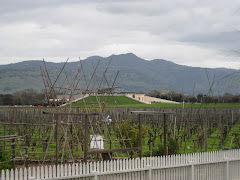
After waking up in our too-cute for words cabin on the mountain overlooking Sonoma at Hanzell, we pile into the car and take off for our appointment at Peter Michael Winery, located on the Sonoma/Napa county line making it tricky for Timmy to locate (Melissa's note: slightly dehydrated and it makes a scratching noise when I blink; and I have to drive today).
After taking an amazing drive around the property with Peter Kay, our gracious host, we sat down and did a tasting which included my 2 favorites the Sauvignon Blanc and Pinot Noir
Off to Gary Farrell, which is far far away in upper Sonoma it seems. We taste thru some current releases with a Christopher Walken look-a-like and head off to Gourmet Mushroons for our mycology lesson (Kelly will insert pictures soon!!)
After we learn the ropes of fungus growing, we hit the rib shack in Calistoga and head back to our very elegant accomadations for the evening at Peter Michael. Kim and Mel hit the hot tub, while Kel watches the Duke/UNC game. Quiet night...
Wednesday, February 6, 2008


Peter Michael Winery
 The label on the back of each bottle of Peter Michael wine simply says, “Mountain vineyards, classical winemaking, limited production.” Each of these three elements forms an essential component in the final product but it is the mountain vineyards which hold pride of place.
To drink a Peter Michael wine is to experience the flavor and aromas of a vineyard. The philosophy of the winery is irrevocably purist-whatever the vineyard gives becomes the wine. Winemaking serves exclusively to preserve the quintessential character, flavor and personality of each vineyard so as to convey a sense of place or “terroir.”
Notably, the grapes for all Peter Michael wines are grown on steep volcanic mountain slopes of up to 40 degrees. These slopes are oriented toward the morning sun, maximizing light and gentle warmth. The breezes from the Pacific coast to the west cool the vineyards, slowing the ripening of the fruit.
Due to this slow, gradual ripening, harvest at Peter Michael Winery typically starts three to four weeks later than in the valleys, ensuring full physiological maturity of the fruit. In the Les Pavots vineyard, this is especially important as the tannins have shed their harsh edge and the flavors are concentrated and complex.
The views from these mountainous vineyards perched nearly 2,000 feet above sea level on the western face of Mount St. Helena are breathtaking. Only the hardy and sure-footed can navigate these slopes whose vine rows plunge straight down the mountainside without a terrace to block them. The vineyard's volcanic-origin rhyolitic soils are extremely rocky and well drained which keeps yields low. The soils are also high in potassium, which boosts photosynthesis imparting deeper color and flavor to the grapes. Extremely rare in wine growing regions, rhyolitic soils are one of the most prized of all wine growing soils. Their rare mineral composition gives grapes exceptionally distinctive flavors and aromas.

The estate Chardonnay vineyards are planted at the highest and coolest elevations on the property, nearly 2,000 feet above sea level. The Chardonnay clones planted in these vineyards are all descended from Corton Charlemagne and have been selected for their low yields which create intense flavors and aromas.
Peter Michael's Les Pavots vineyard is planted to Cabernet Sauvignon, Merlot and Cabernet Franc just below the Chardonnay vineyards at around the 1,500 foot level in extremely rocky volcanic soils. Cuttings for the Cabernet Sauvignon came from the famous Bella Oaks vineyard, the Merlot from the Three Palms, Winery Lake and Truchard vineyards, and the Cabernet Franc from the Madrona Ranch. All are classical, small-cluster clones valued for producing wines with the concentration and structure of a first growth.
To ensure intensity of flavor, the winemaker is severe in keeping the densely planted vine canopies small and growth in check. We call this “bonsai-ing” the vines. Each vineyard site was chosen following extensive research of the soil, climate and grape variety. The cost of planting and farming the mountain vineyards here is at least three times that for valley-floor sites and, of course, hand picking has to be the rule. No machines can navigate these steep slopes.
Granted, the costs are enormous and the yields are low. But since it is here in the mountains where the finest wine grapes are grown, this is where Peter Michael has staked its commitment to quality.
Gary Farrell Wines
Pre Harvest Decisions
Once the ultra–premium fruit source has been established, there are many additional decisions the winemaker must consider, which may significantly impact the quality and style of wines produced. After the grapevine sets its crop, they must evaluate the relationship between the bunch–count and potential vine vigor, and remove fruit (if necessary) to ensure proper balance. If the fruit–load is excessive, the resulting grapes could lack the flavor intensity and acid–balance essential for wine quality. If too many bunches are removed, the resulting fruit could ripen too quickly also resulting in diminished quality.
The finest fruit typically comes from vines whose vigor is controlled, and whose crop size is relatively small, but in balance with such vigor. The timing of harvest is also critical in determining the quality and style of wines produced. Grapes of intermediate maturity may produce fruitier, crisper, but less complex wines than fully mature grapes. On the other hand, over–ripe fruit may produce fat, unbalanced wines with excessive alcohol. Some winemakers rely on simple sugar/acid ratios to determine grape maturity. More experienced producers understand that full flavorfruit–focused style, emphasizing elegance, balance, and crisp, refreshing acidity, we favor vineyard sources where full flavor maturity is obtainable at lower sugar levels.
By doing so, they are able to produce fully flavored, age–worthy wines, which are not compromised by excessive alcohol.
Fruit Harvesting
Hand harvesting in the early morning hours is essential for producing optimum quality wines. Though most wine grapes in California are now machine harvested, hand harvesting provides the opportunity to reject immature, raisined or otherwise imperfect fruit.
Additionally, hand harvested fruit can be carefully collected and placed in containers to minimize breakage. Receiving the fruit in cool, undamaged condition will significantly minimize unwanted oxidation and potential growth of undesirable microorganisms on the berries or released juice. As a final precaution, the fruit is again hand–sorted immediately upon arrival to the winery just prior to processing. This level of care is extremely time consuming, and completely impractical for the larger producer but essential for the level of quality we are committed to produce. …even the slightest compromise in grape quality eliminates any possibility of greatness in the resulting wine…
Once the ultra–premium fruit source has been established, there are many additional decisions the winemaker must consider, which may significantly impact the quality and style of wines produced. After the grapevine sets its crop, they must evaluate the relationship between the bunch–count and potential vine vigor, and remove fruit (if necessary) to ensure proper balance. If the fruit–load is excessive, the resulting grapes could lack the flavor intensity and acid–balance essential for wine quality. If too many bunches are removed, the resulting fruit could ripen too quickly also resulting in diminished quality.
The finest fruit typically comes from vines whose vigor is controlled, and whose crop size is relatively small, but in balance with such vigor. The timing of harvest is also critical in determining the quality and style of wines produced. Grapes of intermediate maturity may produce fruitier, crisper, but less complex wines than fully mature grapes. On the other hand, over–ripe fruit may produce fat, unbalanced wines with excessive alcohol. Some winemakers rely on simple sugar/acid ratios to determine grape maturity. More experienced producers understand that full flavorfruit–focused style, emphasizing elegance, balance, and crisp, refreshing acidity, we favor vineyard sources where full flavor maturity is obtainable at lower sugar levels.
By doing so, they are able to produce fully flavored, age–worthy wines, which are not compromised by excessive alcohol.
Fruit Harvesting
Hand harvesting in the early morning hours is essential for producing optimum quality wines. Though most wine grapes in California are now machine harvested, hand harvesting provides the opportunity to reject immature, raisined or otherwise imperfect fruit.
Additionally, hand harvested fruit can be carefully collected and placed in containers to minimize breakage. Receiving the fruit in cool, undamaged condition will significantly minimize unwanted oxidation and potential growth of undesirable microorganisms on the berries or released juice. As a final precaution, the fruit is again hand–sorted immediately upon arrival to the winery just prior to processing. This level of care is extremely time consuming, and completely impractical for the larger producer but essential for the level of quality we are committed to produce. …even the slightest compromise in grape quality eliminates any possibility of greatness in the resulting wine…
Subscribe to:
Posts (Atom)