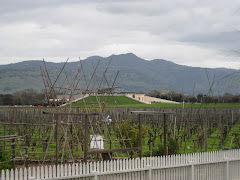
Hanzell Vineyards’ forty-two acres of Chardonnay and Pinot Noir are planted on the  slopes of
the Mayacamas Mountains, just north of the Sonoma Plaza. The original planting, the
Ambassador’s 1953 Vineyard, continues to produce to this day and is now the oldest Pinot Noir
and Chardonnay vineyard in California. The Hanzell clone Pinot Noir and Chardonnay on this
historic vineyard are regarded as important heritage clones of California and the budwood has
been propagated to establish other vineyards throughout California and Oregon.
The Chardonnay:
Hanzell Vineyard’s Chardonnay vines came from Wente clone cuttings of Fred McCrea's
vineyard at Stony Hill. This shy-bearing selection is notable for millerendage, locally known
as “hens and chicks”, in which a cluster of grapes contains a few normal-size berries but is
mostly populated by numerous small and seedless berries. The consistent small berry size
of the Hanzell clone is extraordinary in that the phenomenon is more exaggerated than in
the dwindling other “Old Wente” plantings in the California. It is the defining
characteristic of Hanzell’s Chardonnay and confers distinction on our wines.
The Pinot Noir:
Paul Masson imported cuttings from Burgundy in the late 1800s that are the known
forebears to the Mt. Eden selection (Martin Ray) which receives much credit as a heritage
selection of Pinot Noir in the New World. The subsequent generations of the lineage are
represented by Hoffman Mountain, Joseph Swan, Rochioli, Hirsch and on down. We
believe that the provenance of the Hanzell clone was originally from Paul Masson also,
and that at some point the clone was planted at To Kalon Vineyard in Napa Valley when
Ivan Schoch acquired the budwood for To Kalon’s owner, Martin Stelling. Ivan Schoch
was Hanzell’s vineyard manager when Ambassador Zellerbach planted Hanzell in 1953.
It was Schoch who introduced the Mt. Eden budwood from To Kalon cuttings to Hanzell
Vineyards.
The Hanzell clone is characterized by a high incidence of millerendage, in which pollination
fails and the grapes have no seeds. One ramification of a seedless grape is the restriction
on the size to which the grape can grow. It is quite common on a cluster of Hanzell clone
Pinot Noir to find the majority of grapes are less than the size of peas. Size matters with
red grapes, as the skin, representing the surface area, is the main source of pigment,
tannin and flavor. Smaller berries have a higher surface area to volume ratio and thus a
proportionately greater reservoir of extractable compounds. The resulting wines are
darker, more tannic, and intensely flavored.
 slopes of
the Mayacamas Mountains, just north of the Sonoma Plaza. The original planting, the
Ambassador’s 1953 Vineyard, continues to produce to this day and is now the oldest Pinot Noir
and Chardonnay vineyard in California. The Hanzell clone Pinot Noir and Chardonnay on this
historic vineyard are regarded as important heritage clones of California and the budwood has
been propagated to establish other vineyards throughout California and Oregon.
The Chardonnay:
Hanzell Vineyard’s Chardonnay vines came from Wente clone cuttings of Fred McCrea's
vineyard at Stony Hill. This shy-bearing selection is notable for millerendage, locally known
as “hens and chicks”, in which a cluster of grapes contains a few normal-size berries but is
mostly populated by numerous small and seedless berries. The consistent small berry size
of the Hanzell clone is extraordinary in that the phenomenon is more exaggerated than in
the dwindling other “Old Wente” plantings in the California. It is the defining

characteristic of Hanzell’s Chardonnay and confers distinction on our wines.
The Pinot Noir:
Paul Masson imported cuttings from Burgundy in the late 1800s that are the known
forebears to the Mt. Eden selection (Martin Ray) which receives much credit as a heritage
selection of Pinot Noir in the New World. The subsequent generations of the lineage are
represented by Hoffman Mountain, Joseph Swan, Rochioli, Hirsch and on down. We
believe that the provenance of the Hanzell clone was originally from Paul Masson also,
and that at some point the clone was planted at To Kalon Vineyard in Napa Valley when
Ivan Schoch acquired the budwood for To Kalon’s owner, Martin Stelling. Ivan Schoch
was Hanzell’s vineyard manager when Ambassador Zellerbach planted Hanzell in 1953.
It was Schoch who introduced the Mt. Eden budwood from To Kalon cuttings to Hanzell
Vineyards.

The Hanzell clone is characterized by a high incidence of millerendage, in which pollination
fails and the grapes have no seeds. One ramification of a seedless grape is the restriction
on the size to which the grape can grow. It is quite common on a cluster of Hanzell clone
Pinot Noir to find the majority of grapes are less than the size of peas. Size matters with
red grapes, as the skin, representing the surface area, is the main source of pigment,
tannin and flavor. Smaller berries have a higher surface area to volume ratio and thus a
proportionately greater reservoir of extractable compounds. The resulting wines are
darker, more tannic, and intensely flavored.





No comments:
Post a Comment