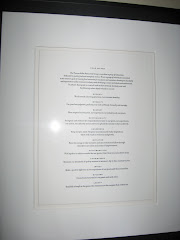
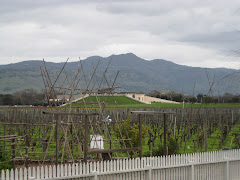
After waking up in our too-cute for words cabin on the mountain overlooking Sonoma at Hanzell, we pile into the car and take off for our appointment at Peter Michael Winery, located on the Sonoma/Napa county line making it tricky for Timmy to locate (Melissa's note: slightly dehydrated and it makes a scratching noise when I blink; and I have to drive today).
After taking an amazing drive around the property with Peter Kay, our gracious host, we sat down and did a tasting which included my 2 favorites the Sauvignon Blanc and Pinot Noir
Off to Gary Farrell, which is far far away in upper Sonoma it seems. We taste thru some current releases with a Christopher Walken look-a-like and head off to Gourmet Mushroons for our mycology lesson (Kelly will insert pictures soon!!)
After we learn the ropes of fungus growing, we hit the rib shack in Calistoga and head back to our very elegant accomadations for the evening at Peter Michael. Kim and Mel hit the hot tub, while Kel watches the Duke/UNC game. Quiet night...
Wednesday, February 6, 2008


Peter Michael Winery
 The label on the back of each bottle of Peter Michael wine simply says, “Mountain vineyards, classical winemaking, limited production.” Each of these three elements forms an essential component in the final product but it is the mountain vineyards which hold pride of place.
To drink a Peter Michael wine is to experience the flavor and aromas of a vineyard. The philosophy of the winery is irrevocably purist-whatever the vineyard gives becomes the wine. Winemaking serves exclusively to preserve the quintessential character, flavor and personality of each vineyard so as to convey a sense of place or “terroir.”
Notably, the grapes for all Peter Michael wines are grown on steep volcanic mountain slopes of up to 40 degrees. These slopes are oriented toward the morning sun, maximizing light and gentle warmth. The breezes from the Pacific coast to the west cool the vineyards, slowing the ripening of the fruit.
Due to this slow, gradual ripening, harvest at Peter Michael Winery typically starts three to four weeks later than in the valleys, ensuring full physiological maturity of the fruit. In the Les Pavots vineyard, this is especially important as the tannins have shed their harsh edge and the flavors are concentrated and complex.
The views from these mountainous vineyards perched nearly 2,000 feet above sea level on the western face of Mount St. Helena are breathtaking. Only the hardy and sure-footed can navigate these slopes whose vine rows plunge straight down the mountainside without a terrace to block them. The vineyard's volcanic-origin rhyolitic soils are extremely rocky and well drained which keeps yields low. The soils are also high in potassium, which boosts photosynthesis imparting deeper color and flavor to the grapes. Extremely rare in wine growing regions, rhyolitic soils are one of the most prized of all wine growing soils. Their rare mineral composition gives grapes exceptionally distinctive flavors and aromas.

The estate Chardonnay vineyards are planted at the highest and coolest elevations on the property, nearly 2,000 feet above sea level. The Chardonnay clones planted in these vineyards are all descended from Corton Charlemagne and have been selected for their low yields which create intense flavors and aromas.
Peter Michael's Les Pavots vineyard is planted to Cabernet Sauvignon, Merlot and Cabernet Franc just below the Chardonnay vineyards at around the 1,500 foot level in extremely rocky volcanic soils. Cuttings for the Cabernet Sauvignon came from the famous Bella Oaks vineyard, the Merlot from the Three Palms, Winery Lake and Truchard vineyards, and the Cabernet Franc from the Madrona Ranch. All are classical, small-cluster clones valued for producing wines with the concentration and structure of a first growth.
To ensure intensity of flavor, the winemaker is severe in keeping the densely planted vine canopies small and growth in check. We call this “bonsai-ing” the vines. Each vineyard site was chosen following extensive research of the soil, climate and grape variety. The cost of planting and farming the mountain vineyards here is at least three times that for valley-floor sites and, of course, hand picking has to be the rule. No machines can navigate these steep slopes.
Granted, the costs are enormous and the yields are low. But since it is here in the mountains where the finest wine grapes are grown, this is where Peter Michael has staked its commitment to quality.
Gary Farrell Wines
Pre Harvest Decisions
Once the ultra–premium fruit source has been established, there are many additional decisions the winemaker must consider, which may significantly impact the quality and style of wines produced. After the grapevine sets its crop, they must evaluate the relationship between the bunch–count and potential vine vigor, and remove fruit (if necessary) to ensure proper balance. If the fruit–load is excessive, the resulting grapes could lack the flavor intensity and acid–balance essential for wine quality. If too many bunches are removed, the resulting fruit could ripen too quickly also resulting in diminished quality.
The finest fruit typically comes from vines whose vigor is controlled, and whose crop size is relatively small, but in balance with such vigor. The timing of harvest is also critical in determining the quality and style of wines produced. Grapes of intermediate maturity may produce fruitier, crisper, but less complex wines than fully mature grapes. On the other hand, over–ripe fruit may produce fat, unbalanced wines with excessive alcohol. Some winemakers rely on simple sugar/acid ratios to determine grape maturity. More experienced producers understand that full flavorfruit–focused style, emphasizing elegance, balance, and crisp, refreshing acidity, we favor vineyard sources where full flavor maturity is obtainable at lower sugar levels.
By doing so, they are able to produce fully flavored, age–worthy wines, which are not compromised by excessive alcohol.
Fruit Harvesting
Hand harvesting in the early morning hours is essential for producing optimum quality wines. Though most wine grapes in California are now machine harvested, hand harvesting provides the opportunity to reject immature, raisined or otherwise imperfect fruit.
Additionally, hand harvested fruit can be carefully collected and placed in containers to minimize breakage. Receiving the fruit in cool, undamaged condition will significantly minimize unwanted oxidation and potential growth of undesirable microorganisms on the berries or released juice. As a final precaution, the fruit is again hand–sorted immediately upon arrival to the winery just prior to processing. This level of care is extremely time consuming, and completely impractical for the larger producer but essential for the level of quality we are committed to produce. …even the slightest compromise in grape quality eliminates any possibility of greatness in the resulting wine…
Tuesday, February 5, 2008
De Loach and Hanzell...
We wake up at Michel Schlumberger and do some quick barrel samplings (sans Kel, who declared we are insane for sampling at 9 am Kelly: I was sickie that morning!) with Mike. We pack up,wave good-bye, and head to the first appointment: De Loach.
De Loach is a little larger than most of the production facilities we have seen so far: they just whittled down from 300,000+ cases per year to 125 thou (which is still ALOT!). They dabble in organic practices (which is Melissa's new fav). Lisa and Cindisey host us for lunch at a lovely vineyard side abode. Cindisey makes us appointment for Gourmet Mushrooms tour the following day.
After we finish up at De Loach, we are heading to the town of Sonoma to tour and stay the night at Hanzell Winery, which is tucked away at the very tip top of a mountain. We toured around with the winemaker Michael (Melissa's note: from the very top of a Chardonnay vineyard, you can see all the way to San Fran and the bay area).
For dinner, we piled in the car, said a quick prayer and speed down the mountain to Sonoma for a bite at Cafe La Haye, where we also shared a bottle of Spottswoode Sauvignon Blanc. Afterwards, we sped back UP the mountain and listened to rap music (I kid you not), and drank wine by the fire.
Hanzell Vineyards
Hanzell Vineyards’ forty-two acres of Chardonnay and Pinot Noir are planted on the  slopes of
the Mayacamas Mountains, just north of the Sonoma Plaza. The original planting, the
Ambassador’s 1953 Vineyard, continues to produce to this day and is now the oldest Pinot Noir
and Chardonnay vineyard in California. The Hanzell clone Pinot Noir and Chardonnay on this
historic vineyard are regarded as important heritage clones of California and the budwood has
been propagated to establish other vineyards throughout California and Oregon.
The Chardonnay:
Hanzell Vineyard’s Chardonnay vines came from Wente clone cuttings of Fred McCrea's
vineyard at Stony Hill. This shy-bearing selection is notable for millerendage, locally known
as “hens and chicks”, in which a cluster of grapes contains a few normal-size berries but is
mostly populated by numerous small and seedless berries. The consistent small berry size
of the Hanzell clone is extraordinary in that the phenomenon is more exaggerated than in
the dwindling other “Old Wente” plantings in the California. It is the defining
characteristic of Hanzell’s Chardonnay and confers distinction on our wines.
The Pinot Noir:
Paul Masson imported cuttings from Burgundy in the late 1800s that are the known
forebears to the Mt. Eden selection (Martin Ray) which receives much credit as a heritage
selection of Pinot Noir in the New World. The subsequent generations of the lineage are
represented by Hoffman Mountain, Joseph Swan, Rochioli, Hirsch and on down. We
believe that the provenance of the Hanzell clone was originally from Paul Masson also,
and that at some point the clone was planted at To Kalon Vineyard in Napa Valley when
Ivan Schoch acquired the budwood for To Kalon’s owner, Martin Stelling. Ivan Schoch
was Hanzell’s vineyard manager when Ambassador Zellerbach planted Hanzell in 1953.
It was Schoch who introduced the Mt. Eden budwood from To Kalon cuttings to Hanzell
Vineyards.
The Hanzell clone is characterized by a high incidence of millerendage, in which pollination
fails and the grapes have no seeds. One ramification of a seedless grape is the restriction
on the size to which the grape can grow. It is quite common on a cluster of Hanzell clone
Pinot Noir to find the majority of grapes are less than the size of peas. Size matters with
red grapes, as the skin, representing the surface area, is the main source of pigment,
tannin and flavor. Smaller berries have a higher surface area to volume ratio and thus a
proportionately greater reservoir of extractable compounds. The resulting wines are
darker, more tannic, and intensely flavored.
 slopes of
the Mayacamas Mountains, just north of the Sonoma Plaza. The original planting, the
Ambassador’s 1953 Vineyard, continues to produce to this day and is now the oldest Pinot Noir
and Chardonnay vineyard in California. The Hanzell clone Pinot Noir and Chardonnay on this
historic vineyard are regarded as important heritage clones of California and the budwood has
been propagated to establish other vineyards throughout California and Oregon.
The Chardonnay:
Hanzell Vineyard’s Chardonnay vines came from Wente clone cuttings of Fred McCrea's
vineyard at Stony Hill. This shy-bearing selection is notable for millerendage, locally known
as “hens and chicks”, in which a cluster of grapes contains a few normal-size berries but is
mostly populated by numerous small and seedless berries. The consistent small berry size
of the Hanzell clone is extraordinary in that the phenomenon is more exaggerated than in
the dwindling other “Old Wente” plantings in the California. It is the defining

characteristic of Hanzell’s Chardonnay and confers distinction on our wines.
The Pinot Noir:
Paul Masson imported cuttings from Burgundy in the late 1800s that are the known
forebears to the Mt. Eden selection (Martin Ray) which receives much credit as a heritage
selection of Pinot Noir in the New World. The subsequent generations of the lineage are
represented by Hoffman Mountain, Joseph Swan, Rochioli, Hirsch and on down. We
believe that the provenance of the Hanzell clone was originally from Paul Masson also,
and that at some point the clone was planted at To Kalon Vineyard in Napa Valley when
Ivan Schoch acquired the budwood for To Kalon’s owner, Martin Stelling. Ivan Schoch
was Hanzell’s vineyard manager when Ambassador Zellerbach planted Hanzell in 1953.
It was Schoch who introduced the Mt. Eden budwood from To Kalon cuttings to Hanzell
Vineyards.

The Hanzell clone is characterized by a high incidence of millerendage, in which pollination
fails and the grapes have no seeds. One ramification of a seedless grape is the restriction
on the size to which the grape can grow. It is quite common on a cluster of Hanzell clone
Pinot Noir to find the majority of grapes are less than the size of peas. Size matters with
red grapes, as the skin, representing the surface area, is the main source of pigment,
tannin and flavor. Smaller berries have a higher surface area to volume ratio and thus a
proportionately greater reservoir of extractable compounds. The resulting wines are
darker, more tannic, and intensely flavored.
DeLoach Vineyards
Open Top Wood Fermintors:

Interestingly, open-top wood fermentors-although fairly new to Sonoma-have been used in France for centuries. However, California winemakers have traditionally abandoned open-top fermentors in favor of stainless-steel tanks on the belief that they would facilitate easy-to-control fermentations and predictable results. Greg LaFollette, the DeLoach Vineyards winemaker, prefers to live dangerously: "I don't practice safe winemaking," he says, choosing open-top fermentors and wild yeasts for his delicate Pinot Noirs, "so [the wine] goes to the limit of what it can be." By pushing the envelope, DeLoach Vineyards crafts terroir-driven, delicious wines that are a true expression of our vineyards, passion and expertise.
In 2004, DeLoach Vineyards purchased 15 French oak open-top fermentors specifically for Pinot Noir production. As Russian River Valley winemaking pioneers, DeLoach Vineyards is often the first in the area to employ innovative winemaking techniques like the use of oak open-top fermentors. This innovative step has helped catalyze a movement of winemakers across the region that are employing traditional winemaking techniques like hand-punchdowns (pigage) and gravity-flow systems. During the 2004 vintage, all DeLoach Vineyards Russian River Valley, Vineyard Designate and OFS Pinot Noir were vinified using the open-top fermentors and were punched-down by hand.

Interestingly, open-top wood fermentors-although fairly new to Sonoma-have been used in France for centuries. However, California winemakers have traditionally abandoned open-top fermentors in favor of stainless-steel tanks on the belief that they would facilitate easy-to-control fermentations and predictable results. Greg LaFollette, the DeLoach Vineyards winemaker, prefers to live dangerously: "I don't practice safe winemaking," he says, choosing open-top fermentors and wild yeasts for his delicate Pinot Noirs, "so [the wine] goes to the limit of what it can be." By pushing the envelope, DeLoach Vineyards crafts terroir-driven, delicious wines that are a true expression of our vineyards, passion and expertise.
In 2004, DeLoach Vineyards purchased 15 French oak open-top fermentors specifically for Pinot Noir production. As Russian River Valley winemaking pioneers, DeLoach
 Vineyards is often the first in the area to employ innovative winemaking techniques like the use of oak open-top fermentors. This innovative step has helped catalyze a movement of winemakers across the region that are employing traditional winemaking techniques like hand-punchdowns (pigage) and gravity-flow systems. During the 2004 vintage, all DeLoach Vineyards Russian River Valley, Vineyard Designate and OFS Pinot Noir were vinified using the open-top fermentors and were punched-down by hand.
Monday, February 4, 2008
Dry Creek and Sustainable Farming
Monday Morning, another beautiful day. Kelly is behind the wheel, and take off back towards Sonoma County for our appointments.
A note about Tim-Tim (a.k.a: Timmy T, Tim-Tom, you stupid piece of shit): At the beginning of this trip, I sat on the floor and very carefully programmed the addresses into "Our Favorites". Now sometimes it can be confusing, as the town borders are kind of funky, un-named dirt roads, no street numbers, etc...). Ergo, he occassionally tries to send us off-roading in our little Avenger and tells us we "have reached our destination" 1/2 a mile shy.
We are rolling thru the beautiful hills and curves of the Dry Creek region, blindly following Tim-Tim's direction, when he directs us to "turn left ahead" on a dirt/mud track thru the vineyard. Luckily, we had recently seen a sign for the winery and took off.
Michel Schlumberger is all organic and sustainable farming (no chemicals, no pesticides, let Mother Nature do her thing and keep an eye on the enviroment around you). We are greeted by Jerry (hospitality), Judd (the financial man), and Mike (the wine maker) and set off for a walk around the property. There are chickens (used for pesticide control) and sheep (used for landscaping and mowing), complete with mobile pens that can be moved about. Sheep are preferred over goats, as goats (a) eat everything in sight and (b) chew the grass too low. There are bird house everywhere, with over 45 species on the property.
We wandered around the property, which is also bordered by "wine creek". Mike and the team keep this area "silt free" and the owner installed a rather elaborate drainage system underground to filter/clean the water before dumping it in the steam. Steelhead and Salmon also rush up and spawn in this creek (Melissa's wine pick" The La Brume Chardonnay)
We unpack the little Avenger, which has developed a brake and power steering problem, and head to Seghesio for a tasting. Seghesio is a very old family operation, with Italian roots going back to the Gold rush in the late 1800's. Great zin's (Melissa's pick: Try the Arneis if you can find it).
After Seghesio, we stroll around the town of Healsdsburg (some alone time, if you will). Kim and I grab dinner, while Kelly opts for Thai food at a later time. We head back to Schlumberger, our accomodations for the evening, where Kelly and I sit on our patio overlooking the western portion of the land and Kim heads for a hike (Stories about Mountain lions don't scare her!).
We sit in our courtyard, eating and drinking until the coyotes STOP making noise (Melissa assumes they are on the move) and hit the sack.
Seghesio Family Vineyards
The Seghesio Story begins in 1886 when Edoardo Seghesio departed his family’s vineyards in Piedmonte, Italy for a new life in America. Like so many immigrants, he was drawn to Northern Sonoma County and the Italian Swiss Colony, to follow his passion for winemaking. The “colony,” as it was known, hired immigrants for three year stints, providing room and board and then, a lump sum at the end of those three years enabling employees to buy land or set up a business in their new home.
Soon, Edoardo rose through the ranks to winemaker. Yet, he yearned for home. The Colony’s manager repeatedly encouraged him to stay and finally, it was his niece and the opportunity to purchase land that convinced Edoardo to remain. That young girl, Angela Vasconi and Edoardo were married in 1893. In 1895, they purchased a modest home in northern Alexander Valley, less for the home than the surrounding 56 acres Edoardo recognized as ideal vineyard land. They planted the “Home Ranch” that year to what has become our family’s lifeline – Zinfandel.
Edoardo remained at the Colony while building his own winery in the evenings after work. Upon its completion in 1902, the young couple began Seghesio Winery while raising their five children. In 1910, they acquired additional acreage surrounding the bustling train station in what was then “Chianti, California.” Edoardo, appropriately, planted the 10 acres to the Chianti field blend of Sangiovese, Canielao Nero, Trebbiano and Malvasia. That vineyard, we call Chianti Station is North America’s oldest planting of Sangiovese.
In the years preceding Prohibition, the business flourished and the Seghesio Family gained a reputation for quality wine and their generosity toward others getting their start in this fledgling industry.
Six months prior to Prohibition, and convinced it could not last more than a year, Edoardo made a decision to purchase his former employer, Italian Swiss Colony. The “Colony” with a 4,000,000 gallon capacity winery and its 1100 acres of vineyards were quite a value at $127, 500. As Prohibition prevailed, however, the debt was too much for Edoardo to bear. In 1920, he brought on partners, his brother-in-law, Enrico Prati, and the Rossi Family who were previous owners and at whose request Edoardo came to America. Edoardo sold his shares in 1933.
Upon repeal of Prohibition, the family once again opened the doors of the winery and Seghesio was making a come back. Unfortunately, Edoardo passed away in 1934 leaving the winery and all property to Angela. From then, Angela and her sons, Arthur, Frank and Eugene continued making wines and shipping via the railroad. With their hard-earned knowledge, they added vineyards when they could purchase them without debt. In 1949, they purchased a second winery facility in Healdsburg to enable them to keep up with the growing demand for their wines.
In January 1958, the newspaper headlines read that Sonoma County’s wine industry had lost its matriarch when Angela passed away. Angela’s legacy as an industry leader and a great chef lives on in her grandchildren. Her sons formed a partnership based on the ideals of their parents, family, hard work and passion for the industry.
From the time of Angela’s death until the mid 1970s, the Seghesio Family flourished in the bulk wine business, producing most of the red wine made in Sonoma County. At their largest, 1,700,000 gallons were produced between the original winery in Chianti and the Healdsburg winery. Yet, as the industry evolved, so did the Seghesio family when in 1983, the first wines were bottled under the Seghesio label at the hands of Ted Seghesio, a fourth generation family winemaker.
Ted was the not only the winemaker but sold and delivered wine. In 1986, his cousin Peter Seghesio joined the business and began to set up a distribution network nationwide. By 1993, the Seghesio brand had grown to 130,000 cases of not only the family’s zinfandel and Italian varietals, but also Chardonnay, Cabernet, Sauvignon Blanc and both red and white table wine. It was in that year that the younger generation was given control of the winery. Fortunately, they too shared a passion for the land and a desire to produce wines they were passionate about. They turned their focus to the vineyards and eliminated all but the wines we grow reducing production to 30,000 cases.
Today, they are proud to passionately produce almost exclusively estate wines, some from those same vineyards Edoardo and Angela first planted in the late 1800s.
Michel Schlumberger
 The special growing conditions of Dry Creek Valley give its wines a character of elegance. The relatively cool growing season nourishes a distinctive balance in the Valley's grapes, ripening them slowly and evenly. The French would say point, or just right. Both red and white wine grapes retain a measure of acidity, lending themselves to making exuberant wines with lively flavors. The red wine grapes also typically have healthy levels of tannins. These are unabashed tannins, and the better cabernets in particular wear them like a nicely tailored suit. Acidity provides freshness and lift; tannins provide immense flavor interest that bring a person back again and again. Both allow a wine to age handsomely. Notched into the western edge of Dry Creek Valley like a small amphitheater, Wine Creek Canyon nicely sets the stage for ripening point. The Canyon juts into the coastal range just at Dry Creek's temperate mid-section, piercing the Valley's western flank. Michel-Schlumberger's rolling benches buttress the Canyon's northern hillsides, and generally slope south, an exposure that gives them a full day's worth of sun. At the same time, vineyards on these benches are closer to the ocean than most-the Pacific is only seventeen miles away. Shortly after five o'clock the ocean air arrives, and during the ripening season Michel-Schlumberger's vineyards are among the first to cool down. At the end of a working day, if you were to walk along the forest at the western edge of our vineyards, you would experience this change of climate firsthand. It is the time of day when the sun has closed upon the horizon and shadows are cast long over the vines. Ahead, on the terraced uplands to the north, grow the treasured Jackson clones of cabernet. Most of those vines are still in sunlight, and should you step out into that light, you would feel the heat of a western day. But here in the shadows a distinctly cool and constant breeze has begun to flow out of the trees and into the vineyards. This breeze feels remarkably like air conditioning. Its noteworthy cooling power goes a long way toward explaining how grapes in this little pocket canyon can ripen fully, and succulently, without losing their composure.
On a rare bit of level ground in Wine Creek Canyon sits the white-clad winery of Michel-Schlumberger. On three sides, vineyards are stitched across rolling foothills, and the mission-style structure is nestled comfortably in its surroundings. Wine Creek flows out of the hills and quietly runs by the front of the winery. To one side is a broad shoulder of a bench, ridged along  the top and fanning out down to the road. There are nearly twenty blocks of vineyards (and an olive orchard) on this shoulder with different exposures and elevations. To the other side of the waterway are a series of knolls surrounding a lake above the winery. Each knoll has its peculiarities, hence its own selection of grapes, rootstock, and spacing. Below the lake is another broad shoulder fanning down to the road. The soil here is "river conglomerate," a particularly rocky soil unique to Dry Creek with superb drainage. Above the lake is the terraced upland vineyard, rising steeply to a saddle on the hill. This vineyard grows in the red volcanic soil of Dry Creek Valley's hinterlands, long prized for premium vineyards. In these red volcanic soils grow our Jackson clones of cabernet sauvignon. This species of cabernet (prosaically known as #6)
 takes its name from a long lost vineyard in the Sierra foothills. In the 19th century UC Berkeley maintained it as an index vineyard. Lore has it that the vineyard lay utterly abandoned after Prohibition, only to be re-discovered by a graduate student researching available plant material in the mid-1960s. The really exciting thing about this wild vineyard is that its vines are pre-phylloxera selections, dating from the mid-19th century. They are free of disease and have never had to undergo modern horticultural remedies such as sterilizing heat treatments. These vines also yield meager amounts of grapes, which almost certainly accounts for their lack of acceptance by the grape growers of yesteryear. But while the quantity of grapes may be paltry, the quality of flavor is exceptional, which is why today the Jackson clones are embraced by California's best estate wineries. The Jackson signature is rich varietal spice and earthy minerality with unusually concentrated, lavish, mouth-filling fruitiness, coupled with surprising clarity and elegance- achieved without numbing levels of alcohol. The various Jackson clones of cabernet, petit verdot, and pinot noir are especially promising, and our vineyards include clones of all three varieties. Over the years Michel-Schlumberger has garnered a reputation for its structured and aromatic merlot. Many of our most recently planted merlot clones grow on Riperia Gloria rootstock. Highly regarded in Bordeaux, this rootstock is quite rare in Sonoma County because it is the most vigor-limiting rootstock available-again, meager grapes with exceptional flavors. As in the past, small amounts of cabernet and cabernet franc are blended with the merlot. To add to this complexity, we have planted petit verdot and malbec to blend for color and spice. The syrah vines consist of several clones planted on both the benchlands and on Bradford Mountain, where these vines share our steep slope with five other varieties. Grapes from the mountain have excellent acidities coupled with depth and intensity of flavor; grapes from the benchlands have broader flavors, more generous and less etched in profile. Small amounts of zinfandel and viognier are blended into the syrah. Much the same as grenache in
 southern France, Dry Creek zinfandel gives broad, spicy flavors to syrah's deep dark density. Viognier lifts the aromatics into a lovely perfume. We are making a small amount of pinot noir from two Jackson clones and four Dijon clones recently made available from France. Ours has none of the green flavors and high alcohol that commonly mar new world pinot noir. Rather, it is a wine of fragrance, filled with flavors of pure black cherry fruit, and finishing with length and elegance. Our chardonnay program has been completely renewed. Gone are the old plantings of the Wente clone, long the mainstay of California chardonnay; replacing them are several Dijon clones and the famous Robert Young clone. In the years to come, we will introduce at least one (possibly two, should distinctions merit) vineyard-designated chardonnay. We hope that it will show the real potential of Dry Creek Valley for this variety. Lastly, we will continue to make authentic pinot blanc from Alsatian clones. Jacques Schlumberger's family comes from Alsace
 and this variety is a natural one for us. Our rendition has always been crisp and spry, redolent of fresh melon. The high-density plantings, growing in some of our coolest terroirs, or growing areas, soon will add a further dimension of flavor to this wine. Terroir, a simple concept of place, is not some marketing idea to which we pay lip service. It is a defining idea for Michel-Schlumberger. We have gone to great lengths to match plant material, spacing, and trellising to specific sites in order to best take advantage of each site's characteristics. We farm these parcels conscientiously and ecologically in order to nourish the ground and their vines. The nuance of a great wine, its heart and soul and individuality, comes from the soil and its vines. One can nudge a wine here and there in the cellar, but the quality and personality come from the vineyard.
 the top and fanning out down to the road. There are nearly twenty blocks of vineyards (and an olive orchard) on this shoulder with different exposures and elevations. To the other side of the waterway are a series of knolls surrounding a lake above the winery. Each knoll has its peculiarities, hence its own selection of grapes, rootstock, and spacing. Below the lake is another broad shoulder fanning down to the road. The soil here is "river conglomerate," a particularly rocky soil unique to Dry Creek with superb drainage. Above the lake is the terraced upland vineyard, rising steeply to a saddle on the hill. This vineyard grows in the red volcanic soil of Dry Creek Valley's hinterlands, long prized for premium vineyards. In these red volcanic soils grow our Jackson clones of cabernet sauvignon. This species of cabernet (prosaically known as #6)
 takes its name from a long lost vineyard in the Sierra foothills. In the 19th century UC Berkeley maintained it as an index vineyard. Lore has it that the vineyard lay utterly abandoned after Prohibition, only to be re-discovered by a graduate student researching available plant material in the mid-1960s. The really exciting thing about this wild vineyard is that its vines are pre-phylloxera selections, dating from the mid-19th century. They are free of disease and have never had to undergo modern horticultural remedies such as sterilizing heat treatments. These vines also yield meager amounts of grapes, which almost certainly accounts for their lack of acceptance by the grape growers of yesteryear. But while the quantity of grapes may be paltry, the quality of flavor is exceptional, which is why today the Jackson clones are embraced by California's best estate wineries. The Jackson signature is rich varietal spice and earthy minerality with unusually concentrated, lavish, mouth-filling fruitiness, coupled with surprising clarity and elegance- achieved without numbing levels of alcohol. The various Jackson clones of cabernet, petit verdot, and pinot noir are especially promising, and our vineyards include clones of all three varieties. Over the years Michel-Schlumberger has garnered a reputation for its structured and aromatic merlot. Many of our most recently planted merlot clones grow on Riperia Gloria rootstock. Highly regarded in Bordeaux, this rootstock is quite rare in Sonoma County because it is the most vigor-limiting rootstock available-again, meager grapes with exceptional flavors. As in the past, small amounts of cabernet and cabernet franc are blended with the merlot. To add to this complexity, we have planted petit verdot and malbec to blend for color and spice. The syrah vines consist of several clones planted on both the benchlands and on Bradford Mountain, where these vines share our steep slope with five other varieties. Grapes from the mountain have excellent acidities coupled with depth and intensity of flavor; grapes from the benchlands have broader flavors, more generous and less etched in profile. Small amounts of zinfandel and viognier are blended into the syrah. Much the same as grenache in
 southern France, Dry Creek zinfandel gives broad, spicy flavors to syrah's deep dark density. Viognier lifts the aromatics into a lovely perfume. We are making a small amount of pinot noir from two Jackson clones and four Dijon clones recently made available from France. Ours has none of the green flavors and high alcohol that commonly mar new world pinot noir. Rather, it is a wine of fragrance, filled with flavors of pure black cherry fruit, and finishing with length and elegance. Our chardonnay program has been completely renewed. Gone are the old plantings of the Wente clone, long the mainstay of California chardonnay; replacing them are several Dijon clones and the famous Robert Young clone. In the years to come, we will introduce at least one (possibly two, should distinctions merit) vineyard-designated chardonnay. We hope that it will show the real potential of Dry Creek Valley for this variety. Lastly, we will continue to make authentic pinot blanc from Alsatian clones. Jacques Schlumberger's family comes from Alsace
 and this variety is a natural one for us. Our rendition has always been crisp and spry, redolent of fresh melon. The high-density plantings, growing in some of our coolest terroirs, or growing areas, soon will add a further dimension of flavor to this wine. Terroir, a simple concept of place, is not some marketing idea to which we pay lip service. It is a defining idea for Michel-Schlumberger. We have gone to great lengths to match plant material, spacing, and trellising to specific sites in order to best take advantage of each site's characteristics. We farm these parcels conscientiously and ecologically in order to nourish the ground and their vines. The nuance of a great wine, its heart and soul and individuality, comes from the soil and its vines. One can nudge a wine here and there in the cellar, but the quality and personality come from the vineyard.
Sunday, February 3, 2008
French Laundry...more evidence that we are indeed special.
Chef's Tasting Menu
3 February 2008
3 February 2008
 "Oysters and Pearls"
Sabayon of Pearl Tapioca with Island Creek Oysters and White Sturgeon Caviar
---
Salad of Purple-Top Turnips
Ruby Red Grapefruit, Garden Mache, and Sicilian Pistachio Puree
---
 Confit of Bluefin Tuna
Baby Artichokes, Wilted Arugula, Sweet Peppers and Nicoise Olive Oil
Marinated Spanish Mackerel
Ginger "Pearls," Red Radish, Perilla and Bonito Vinaigrette
---
"Lobster Curry"
Sweet Butter-Poached Maine Lobster "Mitts," Basmati Rice, Cilantro Shoots and Green Curry "Ragout"
---
Four Story Hill Farm "Poularde"
Potato Confit, Melted Green Garlic, Glazed Carrots and Black Truffle Sauce
---
 Snake River Farms "Calotte de Boeuf Grillee"
Lilly Bulb Salad, Crispy Hen-of-the-Woods Mushroom, Broccoli Puree and "Sauce Japonaise"
---
 Mrs. Quicke's Cheddar
Swiss Chard "Subric," San Marzano Tomato Compote and Mustard Seed Emulsion
---
Diane St. Claire Buttermilk Sherbet
with Honey-Glazed Cranberries and Spiced Streusel
---
 Valrhona Chocolate "Dobos"
Chestnut Butter, Candied Chestnuts and Brown Bread Ice Cream
 Maui Pineapple "Pavlova"
Coconut-Pineapple Curd and "Pate de Fruits Exotiques"
---

 "Mignardises"
---
 The wines we enjoyed...
Lazy Creek Vineyards Riesling and
Radio-Coteau "Las Colinas" Syrah
 Heading into the kitchen for a quick tour...
I felt like I took pictures of absolutely everything! Especially the chicken and the lobster! Those pictures must be hidden somewhere....
Blue Sky and sunny day
We wake up to an amazing day in Yountville. I head over to Bouchon Bakery for breakfast goodies and coffee, and we get going for the first AM appointment: Steltzner.
 Enjoying barrel tastings at Steltzner! We love the '06 Syrah!
At Steltzner we go thru a great tasting in the tasting room (with Kory, a native of Akron, OH) and then head down to the caves to try some barrels. We think the '06s in barrels are even better than the '05s we tried in the tasting room; watch out for this next vintage!
After we leave Stelzner we have a bit of time before our next appointment, so we stop by Robert Sinskey for a quick tour. The tasting room is fantastic, and our wines are paired with tiny courses from the open kitchen set up 10 feet away. Our taster is a native of MA as well, and takes us thru a speed walk of the caves and production facilities. (Melissa's note: if you like shellfish, pair with the Robert Sinskey Abraxus, which is a blend of pinot gris, reisling, gewurtz, and pinot blanc. )
 Sinskey's tasting room....
 ....and their library, deep in the caves!
Off to our next appointment: Duckhorn. Enroute, Kelly just happen to mention her father's offer to treat us to dinner at the French Laundry during our stay (menu and pictures to follow). We figure, what the hell, it's Super Bowl Sunday, call, and get a 9pm reservation for the 3 of us.
 We arrive at Duckhorn, and are pretty full of ourselves. We have an appointment for a private tasting and tour, but are once again shuffled in with the yokels from Mississippi and Indiana. We ditch the tour (pictures to follow) and head to a Mexican Cantina (where is the logic in that...9 courses coming soon!) for a lite lunch of fajitas and burritos then back to Mr. Larkin's for the Super Bowl. (Melissa's note: Being trapped in a condo with a Giants fan and a Patriots fan was quite the "Dear Diary" moment. While Kelly's ritual is to sport a "I HATE PEYTON MANNING; ELI SUCKS TOO" shirt and scream at the television, Kim prefers a more passive technique of hiding under the covers of the bed when things aren't looking good for Eli. She can tell by the noise of Kelly and me when she can come out.)
 we survived!
After the Super Bowl, we put on our finest digs and walk (it's literally 100 yards from Sean's) to dinner. Kelly will post it all on it's own, but I will say that we walked home at 1:15 am.
 Enjoying barrel tastings at Steltzner! We love the '06 Syrah!
At Steltzner we go thru a great tasting in the tasting room (with Kory, a native of Akron, OH) and then head down to the caves to try some barrels. We think the '06s in barrels are even better than the '05s we tried in the tasting room; watch out for this next vintage!
After we leave Stelzner we have a bit of time before our next appointment, so we stop by Robert Sinskey for a quick tour. The tasting room is fantastic, and our wines are paired with tiny courses from the open kitchen set up 10 feet away. Our taster is a native of MA as well, and takes us thru a speed walk of the caves and production facilities. (Melissa's note: if you like shellfish, pair with the Robert Sinskey Abraxus, which is a blend of pinot gris, reisling, gewurtz, and pinot blanc. )
 Sinskey's tasting room....
 ....and their library, deep in the caves!
 We arrive at Duckhorn, and are pretty full of ourselves. We have an appointment for a private tasting and tour, but are once again shuffled in with the yokels from Mississippi and Indiana. We ditch the tour (pictures to follow) and head to a Mexican Cantina (where is the logic in that...9 courses coming soon!) for a lite lunch of fajitas and burritos then back to Mr. Larkin's for the Super Bowl. (Melissa's note: Being trapped in a condo with a Giants fan and a Patriots fan was quite the "Dear Diary" moment. While Kelly's ritual is to sport a "I HATE PEYTON MANNING; ELI SUCKS TOO" shirt and scream at the television, Kim prefers a more passive technique of hiding under the covers of the bed when things aren't looking good for Eli. She can tell by the noise of Kelly and me when she can come out.)
 we survived!


Robert Sinskey Vineyards...
Robert Sinskey Vineyards is an organic farm. This means that all grapes used in making RSV  wines have been certified Organic by the California Certified Organic Farmers. Robert Sinskey Vineyards is now one of the largest and most progressive organic vineyard operations in Napa Valley. Organic refers to methods of growing that rely on the earth's natural resources. Pests and weeds are managed using earth-friendly means such as beneficial insects and mechanical controls. Organic farmers work to build natural nutrients in the soil, which help fertilize plants without the use of synthetics. Certified organic produce is grown according to strict standards. CCOF annually inspects farms to insure that no harmful chemicals have been used for at least three years and that growers keep detailed records of their practices.
 wines have been certified Organic by the California Certified Organic Farmers. Robert Sinskey Vineyards is now one of the largest and most progressive organic vineyard operations in Napa Valley. Organic refers to methods of growing that rely on the earth's natural resources. Pests and weeds are managed using earth-friendly means such as beneficial insects and mechanical controls. Organic farmers work to build natural nutrients in the soil, which help fertilize plants without the use of synthetics. Certified organic produce is grown according to strict standards. CCOF annually inspects farms to insure that no harmful chemicals have been used for at least three years and that growers keep detailed records of their practices.
RSV employs a method of organic farming known as Biodynamic. Biodynamics looks at the farm as a whole system of interrelated organisms. The goal is to promote the individual character of the vineyard in order to create unique wines with a sense of place. To illustrate the heart of Biodynamics, we paraphrase this passage from the Biodynamic Farming and Gardening Association:
"Biodynamics is a science of life forces, a recognition of the basic principles at work in nature and an approach to agriculture which takes these principles into account to bring about balance and healing. Biodynamics is an ongoing path of knowledge rather than an assemblage of methods and techniques.Biodynamics recognizes that soil itself can be alive and this vitality supports and affects the quality and health of the plants that grow in it. One of the fundamental efforts is to build up stable humus in the soil through composting.Biodynamic farmers and gardeners aim for quality not quantity."

The cathedral-like winery, carved into the Stags Leap District foothills, is built of native Napa stone and California redwood. Designed by family friend and architect, Oscar Leidenfrost, the RSV winery is the ideal playground for the perfectionist winemaker. The design allows the flexibility to work with many small lots separately and provides the ideal environment for aging wine in an eighteen thousand square foot network of underground caves.
Saturday, February 2, 2008
Leaving Jordan...so sad.
February 2nd...I have indulged in 3 bubble baths in less than 12 hours. I was up just before 6, and my breakfast was delivered to me in my suite at 7:15. Sadly, there is no firewood left, as I seem to have ignited a small forest last night. It is a bit rainy outside, so I stay in bed watching the news and reading the Wall Street Journal, which arrived with my coffee. Kim came in my room around 8:15, when I promptly announced that I was not leaving until they made me. She countered with moving our 10 am appointment, and I got out of bed.

Bubs and bubs

one of our beautiful suites!
We are being hosted (again) by Alexander Valley Vineyards, for a tour of the facility and lunch with the daughter of the owners. Our tour guide, Toni, was great, and we stopped thru caves in pouring rain. AVV uses something like 12 different barrels from all over (Appalachia, Ozarks, France, Hungary, etc..). Lunch was in the original home on the property, which was a one room abode, with walls covered in animals from a hunt on Kenya.
 Melissa, watch out behind you!!!
 Melissa, watch out behind you!!!
 I've seen many whale bones, but I think this is my first elephant tusk!
 The crazy, rotating gravity setup, in a 10-story dome (bomb shelter-esque)
 Fancy-ass computers!
We wave goodbye to Jessica, and head to Yountville, specifically Sean Larkin's condo, where we will be crashing for the next 2 nights. Sean is on the East coast and was kind enough to offer us his home during this time. We unload the little Avenger, say "Cheers" over a bottle of Jordan Chardonnay, and head into Yountville for a quick bite at Pacific Blues Cafe.
 We found lots of Nantucket paraphernalia at Sean's and it felt like home
Alexander Valley Vineyards
Sonoma County’s Alexander Valley was mostly prune orchards and pastures when, in 1962, Maggie and Harry Wetzel purchased a large portion of a homestead built by Cyrus Alexander, the valley’s nineteenth century namesake. Here, in a rural community of family farms and  ranches, the Wetzel family settled. They raised livestock, cultivated bountiful gardens and restored Alexander’s original home, making it the center of family life. With an eye to their neighbors in nearby Napa Valley, the Wetzels boldly planted premium grape varieties, among the first in the area. Then the family built a small winery.
Alexander Valley Vineyard’s first wine was made in 1975. AVV quickly established a reputation for estate grown wines with distinctive varietal character. Acclaimed for crisp Chardonnay and luscious Cabernet Sauvignon, Alexander Valley Vineyards brought recognition to the appellation and became a leading winery in Sonoma County.
Today the Alexander Valley is a prominent appellation known worldwide as the source of elegant, age worthy wines. The Wetzel Family Estate now grows fourteen grape varieties, on diverse sites stretching from the banks of the Russian River up onto the hillsides. Each grape variety is matched to a specific soil type and exposure. Vineyard Manager Mark Houser and Winemaker Kevin Hall work as a team to maximize fruit flavor in the vineyard and to create balanced wines that capture the grapes’ varietal characteristics. Hank Wetzel oversees the vineyard and winery operations, and his wife Linda continues to oversee administration. Now the third generation of Wetzels has joined the winery. Harry Wetzel, IV is assistant winemaker while younger brother Robert is the National Sales Manager.
Alexander Valley Vineyards produces 100,000 cases annually, 17 varietal wines and proprietary blends. Seventy-five percent of AVV’s production is red wine. Chardonnay, Merlot and Cabernet Sauvignon constitute over one-third of total production. Other varietals include Pinot Noir, Zinfandel, Gewurztraminer, Syrah, Sangiovese, Viognier, and Cabernet Franc.
Cyrus, a limited production, proprietary red wine, named in honor of the pioneer Cyrus Alexander, is AVV’s benchmark, honoring the past while signaling the future.
 ranches, the Wetzel family settled. They raised livestock, cultivated bountiful gardens and restored Alexander’s original home, making it the center of family life. With an eye to their neighbors in nearby Napa Valley, the Wetzels boldly planted premium grape varieties, among the first in the area. Then the family built a small winery.
Alexander Valley Vineyard’s first wine was made in 1975. AVV quickly established a reputation for estate grown wines with distinctive varietal character. Acclaimed for crisp Chardonnay and luscious Cabernet Sauvignon, Alexander Valley Vineyards brought recognition to the appellation and became a leading winery in Sonoma County.
Today the Alexander Valley is a prominent appellation known worldwide as the source of elegant, age worthy wines. The Wetzel Family Estate now grows fourteen grape varieties, on diverse sites stretching from the banks of the Russian River up onto the hillsides. Each grape variety is matched to a specific soil type and exposure. Vineyard Manager Mark Houser and
 Winemaker Kevin Hall work as a team to maximize fruit flavor in the vineyard and to create balanced wines that capture the grapes’ varietal characteristics. Hank Wetzel oversees the vineyard and winery operations, and his wife Linda continues to oversee administration. Now the third generation of Wetzels has joined the winery. Harry Wetzel, IV is assistant winemaker while younger brother Robert is the National Sales Manager.
Alexander Valley Vineyards produces 100,000 cases annually, 17 varietal wines and proprietary blends. Seventy-five percent of AVV’s production is red wine. Chardonnay, Merlot and Cabernet Sauvignon constitute over one-third of total production. Other varietals include Pinot Noir, Zinfandel, Gewurztraminer, Syrah, Sangiovese, Viognier, and Cabernet Franc.
Cyrus, a limited production, proprietary red wine, named in honor of the pioneer Cyrus Alexander, is AVV’s benchmark, honoring the past while signaling the future.
Palmaz Vineyards
 The vineyards grow in more than fourteen unique terroirs at three elevations — 400, 1200, & 1400 feet above sea level and are nurtured by sustainable agriculture. They thrive on the slopes of Mount George at the southern end of the Vaca Range. The foundation for it all is base rock laid down during the Pliocene volcanic age. Geography ranges from steep slopes with shallow nutrient-poor soils, which produce concentrated grapes, to stony colluvial deposits made up of cobbles, gravel, and sandy loam. Variations of soil type, sun exposure, & elevation produce a range of flavors and concentration to create a wine with balance & complexity.
The winery’s 24 fermentation tanks accommodate the yields of individual blocks within the estate, vinifying each parcel’s grapes separately to preserve the unique characteristics intrinsic
 to the parcels. This provides a complete and pure palette for the winemaker’s art — tasting, appreciating, and blending individual lots to bring balance to the wine.
The vineyard is planted primarily with Cabernet Sauvignon, plus some small lots of Merlot, Petit Verdot and Cabernet Franc, which are used as blend components for Palmaz wines. The vines are hand pruned and trellised,with production carefully moderated to grow only the finest quality grapes.
Palmaz Vineyards' winemaking and aging takes place within the living rock of Mount George, in a flawlessly engineered maze of tunnels and lofty domes. The height of the wine cave is equivalent to an 18-storey building, providing the vertical range needed for true gravity-flow winemaking.  Thus, the wine is never subjected to the violent agitation of pumping, which can change the wine’s intra-molecular structure. This gentle treatment allows the finest nuances of flavor to develop naturally—the result is a complex, elegant wine.
 Thus, the wine is never subjected to the violent agitation of pumping, which can change the wine’s intra-molecular structure. This gentle treatment allows the finest nuances of flavor to develop naturally—the result is a complex, elegant wine.
Not once, in the complete winemaking process at Palmaz Vineyards, does the wine come in contact with a pump. It is this extraordinarily gentle handling that gives Palmaz wines their unique “hand-made” quality and rare elegance.

Friday, February 1, 2008
Jordan: We are Special!
Jordan Chardonnay grapes grown primarily in the Russian River Valley are the first varietal to ripen for harvest. They are followed by red varietals that compose the Bordeaux-style Cabernet Sauvignon.
The vineyard crews pick the grapes in the cool of the morning while skins are firm. They are placed in 40-pound lugs, which are in turn loaded into gondolas. As the gondolas come into the winery from the vineyard, they are weighed at the scale and samples are taken for sugar analysis and cluster weights. There is a feeling of urgency, excitement and satisfaction in the air.
The grapes are gently removed from their stems in the crusher/de-stemmer. The stems are conveyed into a waiting dump truck that takes them to the vineyards for composting.
After a maximum of one hour of skin contact, pneumatic presses extract juice from the Chardonnay grapes. Cool fermentation in temperature-controlled stainless steel tanks further enhances the natural aromas and flavors of the Chardonnay fruit.
Grapes for Jordan Cabernet Sauvignon, harvested primarily from the estate vineyards in the Alexander Valley - Cabernet Sauvignon, Merlot and Cabernet Franc - ferment slowly in stainless steel holding tanks before pressing, acquiring the necessary extracts, colors and tannins from the skins.
Both Jordan Cabernet Sauvignon and Chardonnay undergo malolactic fermentation in oak casks to soften the natural acidity and enrich the wine. The young wines then age gradually in oak barrels selected from carefully selected regions of France and America. Blending - a tremendously difficult art born of intuition, skill and experience - balances flavor components to complement the distinctive varietal character of each wine.
Jordan wines are bottled at the estate and aged under optimal cellar conditions before their release to market. The exceptional balance and continuity of style of Jordan Cabernet Sauvignon and Chardonnay are recognized and appreciated not just in the United States, but also around the world.
 the view from just outside our rooms...as the sun is going down

Vineyard 29 and Aida

the front door of 29 is at the top of the picture...you literally do walk right into the winemaking operation! they have gigantic wood fermenting tanks, and their own bottling line. fancy.

looking out the tasting room into the caves of Vineyard 29

Holly bemoans the yokels who crashed our tasting; the upside is we get to taste the '04 Vineyard 29 Cab!
About Vineyard 29:
Teresa Norton & Tom Paine came to Napa Valley in '89 to retire– a dream that was quickly replaced by another when they learned their estate was prime Cabernet Sauvignon territory. In a matter of weeks from purchase of the property, they were putting in a 3-acre vineyard under the watchful eye of lauded Vineyard Manager David Abreu and, within a year, planting cuttings from the Grace Family Vineyard, located 100 yards north.
The first release, 250 cases in '92, was warmly received by press and public alike.
The 92-98 vintages were made at the Grace Family winery with Gary Galleron (92-94) and Heidi Barrett (95-98) as winemakers. In 1999, Philippe Melka became winemaker, bringing about an important unification of vineyard and winery interests, as he applies his geological and viticultural expertise and Bordelais background to both the vines and the winemaking process. The '99 harvest was vinified at Miner Family Vineyards while plans were made for a winery and caves on the estate. Late that year, retirement began to sing its siren song again, and Teresa and Tom began considering what the next stage in their life should be. In early 2000, they met Chuck and Anne McMinn, a couple whose interest in the future of Vineyard 29 proved to be as serious as theirs. In a most pleasant transition, Chuck and Anne became the new owners of Vineyard 29 and immediately put the winery and cave plans into motion. Construction is now complete, with the 2002 and 2003 vintages having been vinified entirely here on the estate, and the 2004 vintage underway. The vineyards have also been expanded, with the addition of approximately 2 acres of Cabernet Franc vines, and 1 acre of Sauvignon Blanc. While the 30,000 square foot, 10,000 case winery and cave facility was under construction, Chuck and Anne began thinking about the opportunity to expand yearly production to better utilize the complete hands-on control of their own winery. As fate would have it, an historic piece of vineyard land became available at just the right time. The Aida vineyard, already famous as a source for zinfandel and petite sirah fruit coveted by several well-known winemakers, was 2 miles north of Vineyard 29, in a microclimate unique for the St. Helena appellation, and with soil capable of producing highly distinctive wines with great vineyard character. In January of 2001, Chuck and Anne finalized the purchase of the Aida vineyard, and began upgrading the plantings there to create a "sister" vineyard for 29's home wines. The future of Vineyard 29 now lies in the soil of our estate vineyards. New vine plantings both here at 29 and on the Aida property were harvested for the first time in 2004, allowing for a gradual increase in our production levels from 1,800 cases per year to approximately 3,000. This increase owes itself largely to the 15 acres of vines at Aida, consisting of cabernet sauvignon, zinfandel, merlot and petit verdot. The Vineyard 29 estate vines will continue to produce our eponymous cabernet sauvignon on the same scale as in the past. The growth of this property is seen along recently planted steeply sloping vineyards on the southern and western ridges that frame the winery building. The southern ridge was planted to Cabernet Franc in 2000, and the western ridge was planted to Sauvignon Blanc in 2002; both were harvested for the first time in 2004.
Good-bye casa, hello Jordan
February 1st...we pack up our lives at the Alexander Valley Vineyards and move on. Now that Kim's luggage is here, we are having difficulty shoving everything in the truck.
We head into Healdsburg for breakfast, at Center Street Cafe, which is covered diner-style with comical tin signs (Poop Deck, S.S. Titantic etc...).
After we fuel our bodies we head south to Vineyard 29, where we hook up with Holly for a tour and tasting. We sampled the 4 fantastic wines in the private wine library, which I have decided to build a replica of onto my future home. During this tasting, I was experiencing a bit of a red wine spillage problem; in short it looked like I had been shot on the table. My black Riedel O series spit glass had a crack in it. This will play into a later story as well.

After Vineyard 29, we headed back up to Sonoma, to Jordan Winery. Wow. It's something like 1200 acres, and they only farm Cabernet Sauvignon, Chardonnay, and olives for EVOO. We are shown to our guest suites, which looked like they had been plucked from the Ritz in Paris and plopped down in this Chateau. Kim's overlooked the production facility, while mine and Kelly's sported views of the barrel rooms (locked doors...wise folks). The bathrooms are amazing, and as big as most bedrooms (one suite was larger than my apartment in ACK). Huge bathtubs, down beds, fireplaces, views of vineyards, and cathedral ceilings completed the look. We headed down for the tour and tasting with Scott, and returned to our suites finding bottles of chilled Chardonnay, classical music, and our beds turned down. We promptly met in my suite to toast our lives, which is now a regular pattern. After we all soaked in our respective tubs, we decided that traveling off the property for any reason would be a waste of this amazing lodging, so we donned our bathrobes and dined on cheese, gourmet pizza, roasted chicken, and 3 bottles of wine, with fires blazing (one in each room, just cause we could!)
We head into Healdsburg for breakfast, at Center Street Cafe, which is covered diner-style with
 comical tin signs (Poop Deck, S.S. Titantic etc...).
After we fuel our bodies we head south to Vineyard 29, where we hook up with Holly for a tour and tasting. We sampled the 4 fantastic wines in the private wine library, which I have decided to build a replica of onto my future home. During this tasting, I was experiencing a bit of a red wine spillage problem; in short it looked like I had been shot on the table. My black Riedel O series spit glass had a crack in it. This will play into a later story as well.

After Vineyard 29, we headed back up to Sonoma, to Jordan Winery. Wow. It's something like 1200 acres, and they only farm Cabernet Sauvignon, Chardonnay, and olives for EVOO. We are shown to our guest suites, which looked like they had been plucked from the Ritz in Paris and plopped down in this Chateau. Kim's overlooked the production facility, while mine and Kelly's sported views of the barrel rooms (locked doors...wise folks). The bathrooms are amazing, and as big as most bedrooms (one suite was larger than my apartment in ACK). Huge bathtubs, down beds, fireplaces, views of vineyards, and cathedral ceilings completed the look. We headed down for the tour and tasting with Scott, and returned to our suites finding bottles of chilled Chardonnay, classical music, and our beds turned down. We promptly met in my suite to toast our lives, which is now a
 regular pattern. After we all soaked in our respective tubs, we decided that traveling off the property for any reason would be a waste of this amazing lodging, so we donned our bathrobes and dined on cheese, gourmet pizza, roasted chicken, and 3 bottles of wine, with fires blazing (one in each room, just cause we could!)
Subscribe to:
Posts (Atom)